KEY WORDS
Continental drift – the movement of land caused by tectonic plates moving
Magma – lava when it is underground
Convection currents – currents in the mantle made by moving magma
Destructive plate boundary – a plate boundary where crust is destroyed
Constructive plate boundary – a plate boundary where crust is made
Transform plate boundary – a plate boundary where two plates are sliding past each other
WHAT ARE TECTONIC PLATES?
Tectonic plates are what make up the earth’s crust. We have two types of plate: continental and oceanic.
Continental plates have mostly land on them, and oceanic plates have mostly water. Plates are what cause continental drift. Continental drift is the movement of land. It happens because plates move, so everything on top of them moves. In fact, all of the land in the world used to be in one big continent called Pangaea. But how do they move, and what happens when they do?
SIMPLIFIED –
- Tectonic plates are what make up the earths crust
- There are two types of plate: continental (which have mostly land on them) and oceanic (which have mostly water on them)
- Plates are what cause continental drift, which is the continents moving
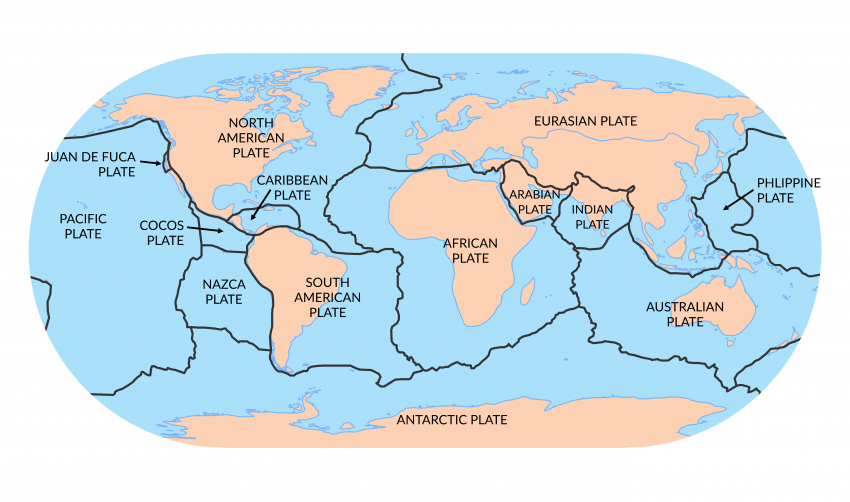
HOW PLATES MOVE AND WHAT HAPPENS WHEN THEY DO?
Tectonic plates move because of convection currents. Convection currents are currents of magma in the mantle. They form when magma is hot. So, because heat rises and the magma is hot, what happens? The magma rises. So, as it rises, it gets colder. And then, as more warm magma from the bottom begins to rise, the magma at the top, because it is no longer that hot, goes down. So, with all of these convection currents moving, because they are just beneath the plates, that makes the plates move. Next I will show you the three ways that plates can move
- This first one is what happens when plates collide. When plates collide, it is called a destructive plate boundary, because crust is being destroyed. It is also known as a divergent. When two plates collide, what happens is that the heavier plate just slides under the other one into the mantle, where the rock melts and becomes magma. Oceanic crust is usually heavier than continental crust, so if they are colliding it is usually the one to dip into the mantle.
When oceanic crust and continental crust collide, then a bit in between them called a trench is formed. An example of a plate boundary of continental with an oceanic plate is the south American and Nazca plate colliding.
But, when two continental pieces of crust collide, they fold upwards, making a fold mountain. These can be found in the Himalayas.
When two oceanic plates collide, the older plate will be forced under. An example of two oceanic plates colliding is the pacific plate and the north American plate colliding.

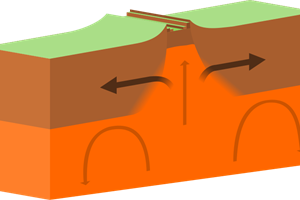
- This next one is all about what happens when two plates start going in different directions. Now, while the last one was called a destructive plate boundary because it broke crust, this one is the opposite because these are constructive plate boundaries because they make crust. These are also known as convergent plate boundaries.
These plate boundaries can make crust because, when a gap starts to form between the plates, magma comes up from the mantle to fill in the gap, and, once it is there, starts to cool, and when it does it becomes rock. This can be found in places like the mid-Atlantic ridge.
- Now, for this last one, this is about when two plates slide past each other. Now, when these two plates are sliding past, these plates might get stuck as the plates get caught on each other. So, because the convection currents are still moving, this means the plates are still trying to move. Because of this, more and more tension gets built up, until suddenly, snap! The plates suddenly jolt after whatever built up the tension broke. It’s a bit like when you might get your jumper caught on a twig, and, as you keep on trying to walk, more and more pressure gets built up on the twig and your jumper until one of them snaps. This type of plate boundary is called a transform boundary.
A famous one of these is the San Andreas fault zone, which goes underwater.
All of these can cause things, like all three can cause earthquakes, but the destructive plate boundaries actually cause 80% of earthquakes. Plate boundaries are actually also where all volcanoes are.
SUMMARY
- Plates move because of convection currents, which are made by the rising and falling of magma because of heat
- There are three types of plate boundary: transform, constructive and destructive
- On a destructive plate boundary, either plates crunch and fold upwards or one dips into the mantle where it melts and turns into magma. These plate boundaries are on boundaries where plates are going towards each other
- On a transform plate boundary, the plates may get caught when going past and, after a long build up of pressure, something may break or move, causing the plates to jolt, usually causing an earthquake. This type of plate boundary is on a boundary where two or more plates are sliding past each other
- A constructive plate boundary is on a boundary where two or more plates are going away from each other. What happens is that when the two plates separate, a gap forms. Magma from the mantle goes up to fill in the gap, but when it goes up it cools off, turning it to stone, forming new crust.
- There are two types of plate: oceanic and continental
- If a plate is an oceanic plate, then that means that there is mostly water on it
- If a plate is a continental plate, then it has mostly land on it